

By Amy Buckner | Trace3 Innovation Researcher
Adopt first, ask questions later. That’s the tactic most enterprises take today when it comes to AI spending and adoption. The headlines prove it. Uber burned through a year’s budget in mere months, AT&T pushed eight billion tokens in a single day, and Microsoft removed Claude Code from 5,000 of its engineers once token costs skyrocketed. The FinOps Foundation's 2026 report found 73% of enterprises exceeded their AI budget projections this year. Companies adopt AI, ship it broadly, and assume economics will sort themselves out. Only after the monthly bill arrives do organizations see how much they’re spending, where tokens are consumed, and whether that investment is generating meaningful value.
AI Costs Don't Scale, They Compound
Because token consumption is inherently unpredictable and scales nonlinearly, AI costs don’t scale; they compound. Tokens are the fundamental unit of AI work and are generally defined as the smallest unit of text a model reads or writes, typically around three to four characters of English text. The challenge is input and output tokens do not have a straightforward relationship, making it difficult to estimate the cost of an agentic workflow in advance. Let’s take coding as an example. Before generating a single line of code, an LLM or agent will ingest a significant amount of context, including repository structures, source files, documentation, and code comments. While input tokens are generally less expensive, they are consumed in a much greater volume than output tokens. Output tokens, on the other hand, are typically more costly (e.g., GPT-5.6 output tokens cost 6x input tokens) but write a much smaller amount of generated content. As a result, AI spend is not simply a matter of how much is read versus how much is written. Additionally, agents may enter iterative loops, repeatedly call tools or APIs, self-correct before reaching an answer, or drift from their original intent altogether.
To complicate it further, every provider prices their models differently, and those prices fluctuate within a single model. Silent upgrades quietly accelerate AI bills, and multiplying that across an organization with several providers scales the problem quickly. Each model adds its own pricing logic, upgrade cadence, and variable to reconcile at the end of the month.
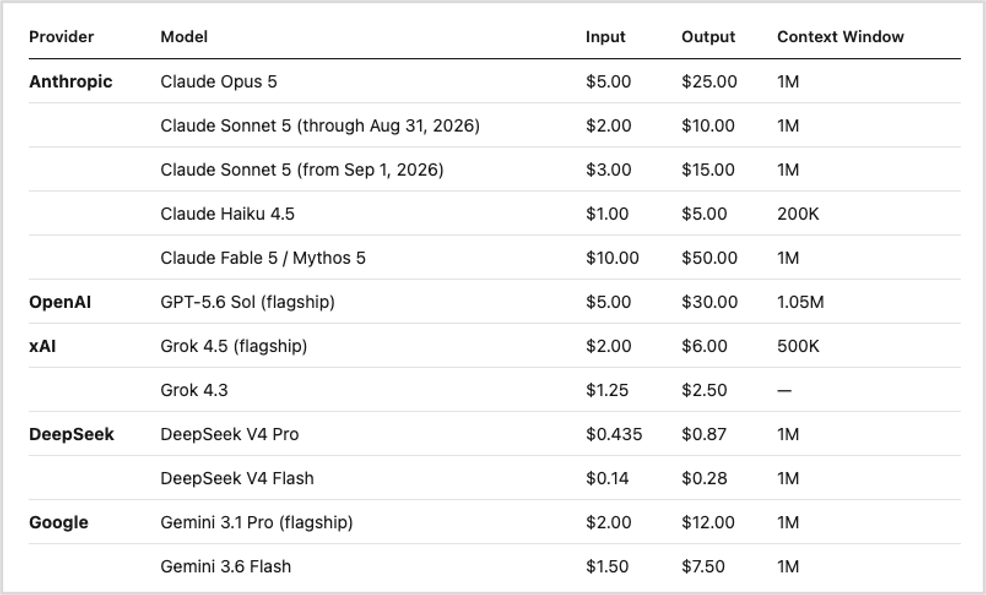
*Innovation in this table last updated 8/11/2026
In an enterprise environment, costs can escalate dramatically as complexity grows from a single AI chatbot, and eventually, entire ecosystems of interconnected agents that rely on one another to produce results. As these agentic workflows expand, it only becomes more difficult to track AI costs. What begins as a straightforward request can rapidly evolve into an interconnected chain of events across multiple models, making the cost of execution near impossible to see in real time. By the end of the month, organizations are left with a bill that reflects AI spend, but with no true trace back to who or what spent it.
The challenge of tracking AI spend becomes even greater when put head-to-head with traditional FinOps solutions, which were built around relatively stable and measurable resources such as compute, storage, and network consumption. Traditional FinOps frameworks were never designed for this level of variability. This is where tokenomics comes into play: the discipline of connecting AI consumption to the value it creates. The goal is to make every AI dollar accountable, measurable, and increasingly productive over time. But before organizations can optimize value, they must first understand where that value originates. That starts with visibility.
The Tech Behind Real-Time Visibility
Managing AI spend doesn’t start with a budget or a cost-cutting plan. It starts with visibility. Right now, most teams only find out what they spend when the bill shows up. That bill might reflect heavier token consumption, an unannounced model upgrade, or a runaway agent loop that produced little value while it burned through budget. That’s a rearview mirror view of spend, not a real-time one.
Real-time AI spend transparency can be achieved in several ways beyond manual tagging approaches traditionally used in Cloud FinOps. To do this, established FinOps tools have added on AI cost tracking features to keep pace with enterprise adoption and rollout of GenAI capabilities. For example, Amnic pulls token consumption in real-time from usage APIs across frontier models, and maps that spend to the teams, API key, and cost centers responsible for it. Vantage extends this approach with LLM token allocation, collecting telemetry from AI gateways and logs to provide visibility down to the individual developer level. CloudZero takes it a step further, focusing on unit economics by normalizing AI spend into metrics such as cost per client, feature, or transaction, helping organizations connect AI costs to business outcomes.
While traditional FinOps tools continue to increase their capabilities, there are a few new AI-native FinOps players on the scene. Revenium, Pay-i, and Larridin sit outside of the LLM request path and ingest usage data after or alongside the call to explain your AI bill. They use an attribution layer that ties spend to the agentic workflow, client, or business outcome that triggered it. Revenium also flags waste and enforces spending guardrails to catch runaway costs before they happen. Pay-i specializes in mapping AI spend to business KPIs to offer financial governance and budget-limit enforcements. These solutions trace business/agent-level attributions, rather than at the infrastructure level, typical of traditional Cloud FinOps tooling. They help teams run agents like a business, tracking ROI, adoption frequency, and business KPIs by use case, rather than just another dashboard. Because token consumption alone does not tell the full story of AI spend, these platforms illuminate the who, what, and where behind AI costs, providing near real-time visibility needed to understand and begin to manage AI economics effectively.
As these solutions continue to emerge, we can expect even greater granularity for token cost and consumption and how that links with real business value and savings over time. To continue the conversation of AI at the FinOps level, check out this article to see how FinOps can bring order to AI spend. If tokenomics strategies and behaviors pique your interest, continue reading on.
Enterprise Strategies for Controlling AI Spend Before it Happens
There are several approaches to manage and control AI spend before it happens. The AI gateways and proxies like Portkey, LiteLLM, TrueFoundry, Requesty, and Trimio sit directly in the request path between the user and the model. They intercept a query and change what happens on the user’s behalf before it ever reaches an LLM. Each platform takes a slightly different approach, but together they represent the primary toolset for enterprises looking to control spend upstream, before a single token is billed. Some of these approaches to cost saving include:
- Least cost model routing (Trimio, Portkey, Requesty, TrueFoundry): each query is processed and routed to the correct LLM using a simple classification and keyword matching. For example, summarization tasks go to smaller, cheaper models, while multi-step reasoning tasks are routed to larger, more expensive ones, with a human-trained router to judge complexity upfront.
- Prompt compression (Trimio, LiteLLM): identifying and removing unimportant input tokens for prompts to reduce redundancy, help structure extraction, and simplify sentence structure without degradations in performance, leading to faster responses and fewer input tokens consumed.
- Prompt caching (Portkey, Requesty, Trimio, TrueFoundry): portions of a prompt that are identical across requests are stored and reused instead of processed as net new each time. Trimio is “cache-aware” meaning it leverages the model’s caching abilities to reduce duplicate work.
- Batch processing (LiteLLM, Portkey, TrueFoundry): grouping of non-urgent requests and processing them asynchronously, leading to less expensive outputs with slower turnaround time.
- Enforcing budget (Portkey, LiteLLM, Requesty, TrueFoundry): applying usage limits and quotas to define how many resources can be consumed, throttling and rate limiting for non-essential or experimental agent workloads, and implementing anomaly detection to avoid runaway jobs or sudden increases in API calls or GPU hours
Not every fix has to come from an external tool. At the individual level, small, repeatable habits can meaningfully shift how efficiently AI gets used in day-to-day work. These tactics and mindset shifts move from a world of token-maxxing to value-maxxing, which matters more than ever as organizations tighten AI budgets and start to ask the questions of how AI spend ties to business ROI. Here are a few strategies to get started:
- Route tasks to the right-sized model
Not every task needs your most powerful and most expensive provider. Simple summaries, translations, and rewrites work perfectly fine with smaller, cheaper models like Claude Haiku. This single change is often where organizations see the largest immediate cost drop, since it doesn’t require rewriting prompts at all, merely directing traffic down the most cost-efficient path. - Cap your output length
Since output tokens cost more than input tokens, responses that overexplain or produce an answer in the wrong format can quietly scale your bill. To combat this, set a max_tokens parameter to force the ceiling. If you only need a single line classification, cap the token output at 10-15 tokens to prevent it from returning a verbose response. - Structure prompts to maximize cache hits
Prompt caching works best when the order of the prompt information is identical across requests. When writing prompts, keep the instructions and boilerplate first for a better chance at a cache hit, and include variable information (e.g., date, specific questions, etc.) at the end of the prompt. - Compress context documents
Pasting a full 50-page PDF when the model only needs to process a page or two means you’re paying to process dead weight. Before sending a document, ask what the model actually needs to output a response. Pull only the relevant section, table, or paragraph rather than the whole file. File format matters too: a PDF carries layout and formatting, where a markdown or plain text file strips out that overhead, costing less to ingest.
How to Get Started
Most companies aren’t yet capturing token spend, much less actively managing it. Where you start depends on where your organization is in your GenAI adoption journey and whether your usage is engineering-heavy or productivity-heavy. Here are four moves to help prioritize AI spend:
- Audit before you optimize: Before picking up a new technology or technique, spend time tracking where tokens are being spent, whether that’s by team, by model, or per use case. Tokenomics starts with visibility into your AI spend as it happens, not a postmortem on last month’s bill.
- Match your visibility strategy to your org type: developer-heavy orgs should instrument at the individual developer/agent level first. This provides a baseline mapping to who is consuming what and for how much. Prioritize cache-friendly developer habits early, since coding agents reload repo context on nearly every call, making caching an early win. Productivity-heavy orgs should instrument at the department level instead and emphasize employee behaviors for routing to cheaper models and capping output length as an early win.
- Pick one metric that ties spend to outcomes: As more companies initiate ROI conversations, begin to map SWE hours saved and cost per resolved ticket, it’s important to start reporting alongside sheer token spend. This is the first step toward a defensible token strategy and the foundation for an ROI conversation with leadership.
If you’re curious to learn more or want to stay on top of the latest developments in Innovation, feel free to reach out to us at innovation@trace3.com.

Amy Buckner is an Innovation Researcher at Trace3 where she focuses on scouting and vetting emerging technology trends and enterprise solutions. Her work centers on uncovering early signals, evaluating disruptive solutions, and leading with data-backed recommendations. She’s driven by curiosity, energized by complex problems, and committed to turning emerging ideas into meaningful, strategic outcomes.