

By Ben MacGillivray | Cloud FinOps Consultant
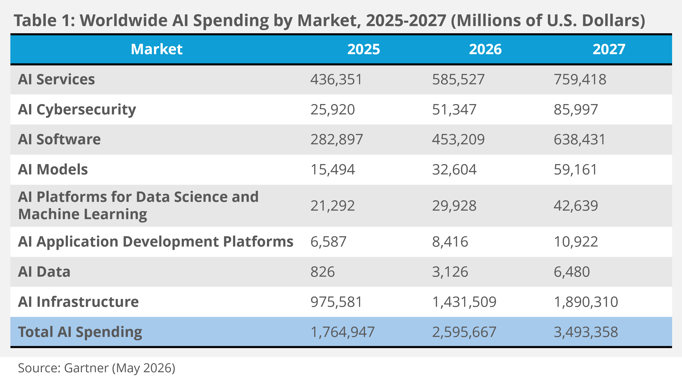
Gartner projects worldwide AI spending will reach $2.59 trillion in 2026, a 47% year over year increase. At this year’s FinOps X conference, the numbers confirmed what Trace3’s team heard directly from clients: 98% of FinOps practices now manage AI costs, up from just 31% two years ago. The discipline has changed fast.
The question is no longer just, “Should we invest in AI?” It is now, “How do we keep up with the pace of AI spend, protect budgets, and prove whether these investments are creating measurable value?” Client requests for visibility, governance, and optimization around AI investments have grown significantly since the start of the year. Business and technology leaders are feeling the pressure to understand where AI spend is going, who owns it, and whether it is delivering the value expected.
Gartner’s forecast shows why that pressure is building. AI infrastructure represents the largest share of projected AI spending, but the growth is not limited to infrastructure. AI services, software, models, cybersecurity, data, and application development platforms are all expanding, which means AI cost management is quickly becoming a broader technology value challenge, not just a cloud infrastructure problem.
The Shift Toward AI FinOps
That growth is why FinOps matters now. FinOps was built to bring financial accountability to enterprise cloud adoption, and the same principles of visibility, optimization, governance, and accountability apply directly to AI. However, AI introduces a new challenge.
Cloud adoption was largely driven by infrastructure and scalability needs, but AI has a far broader set of use cases, making it relevant to nearly every organization. AI has a lower barrier to entry and creates a much larger need for visibility, governance, and cost accountability across the business. Add token-based pricing that behaves nothing like traditional compute, where costs scale with usage patterns that are hard to predict, and you have a recipe for spending that can accelerate faster than one can react.
Organizations building AI cost habits now will be better positioned as AI moves from experimentation to enterprise scale. Those who wait will be scrambling to retrofit governance onto a spend profile already grown out of control.
Visibility for AI: You Can’t Govern What You Can’t See
For most organizations, AI spend is fragmented across multiple platforms (AWS Bedrock, Azure OpenAI, GCP Vertex AI, direct LLM APIs, and GPU infrastructure) with no single view of what is being consumed, by whom, or for what purpose.
In response, we are seeing tooling consolidate AI spend into a single view across providers, surface token-level costs, and attribute spend back to teams, services, and workloads driving it. That includes analyzing models, token usage patterns, inference endpoints, and the underlying infrastructure supporting those workloads.
That level of visibility gives FinOps, finance, and engineering teams a consistent starting point before anyone tries to optimize or govern AI spend. Without it, every conversation about AI costs starts with a different number.
Without consolidated visibility, AI spend becomes a black hole on the P&L. Growing fast, owned by no one, and impossible to optimize. Visibility is not optional; it is the foundation for everything else.
Optimization for AI: Is Your AI Spend Actually Efficient?
Once teams can see where AI spend is coming from, the next question is whether that spend is working hard enough. AI optimization is not just about cutting costs; it is about making sure every dollar is delivering value.
That can include evaluating provisioned throughput versus pay-as-you-go usage, identifying idle inference endpoints or unused GPU capacity, reviewing model selection for cost-to-performance fit, and improving prompt caching to reduce cost per inference.
The optimization tooling we are evaluating surfaces opportunities that traditional cost tools often miss, including underutilized provisioned capacity, model migration opportunities, token economic inefficiencies, and GPU rightsizing.
This shifts the conversation from “what did we spend?” to “is our spend efficient?”, and gives engineering teams specific, actionable opportunities rather than vague directives to cut costs.
The opportunity for optimization is often there, but it is not always obvious. Idle endpoints, over-provisioned capacity, inefficient model choices, and token-heavy usage patterns become actionable only when teams can connect usage, ownership, and cost.
Governance for AI: Guardrails Without Slowing Innovation
As AI moves further from experimentation to production, the absence of governance does not protect speed; it creates risk. Teams need a way to connect AI spend to ownership and action without building a bureaucratic bottleneck.
The tooling responding to this need attributes AI costs to engineering teams, services, and environments, then routes optimization opportunities into the tools engineers already use (Jira, ServiceNow, Slack, and Microsoft Teams). The strongest approaches are built around continuous posture management: observe inefficiencies, assign ownership, provide engineering context, act through existing workflows, and verify savings.
This makes AI cost accountability an ongoing process rather than a monthly finance review. Accountability is built into the way teams already operate, not bolted on top of it.
This is the difference between AI spend that grows with intention and AI spend that just grows. Governance does not have to slow innovation. Done right, it enables teams to move faster with confidence.
What’s Next: A Closer Look at the Partners Solving This
The capabilities described above are not theoretical; we are seeing partners bring them to the market today. In a series of follow-on articles, we will take a closer look at the standout partners and technology we are working with, focusing on one or two specific AI use cases for each and the capabilities where they stand out. Keep an eye out for those focused deep dives in the coming months.
Start Managing AI Spend Today
We are still in the early days of AI cost management, but the gap between organizations with strong habits and those without is already widening. Every team running AI workloads should be able to answer four questions:
- What’s driving AI spend?
- Who owns AI spend?
- What is the value of your AI investment?
- How is AI spend governed?
If those answers are not clear, Trace3’s FinOps team is here to help. As consultants, our team has the benefit of working with a variety of tools, platforms, and solutions across client environments. Our recommendations are driven by use case, not by a single preferred technology. Because we regularly evaluate how different solutions address AI spend visibility, optimization, governance, ownership, and cost accountability, we help clients identify the right fit for their specific challenges.
Reach out to us at finopsteam@trace3.com to schedule a 30-minute AI spend review; we will help you understand where your AI costs stand today and where to focus first.
References
-
Gartner. " Gartner Forecasts Worldwide AI Spending to Grow 47% in 2026." May 19, 2026. https://www.gartner.com/en/newsroom/press-releases/2026-05-19-gartner-forecasts-worldwide-ai-spending-to-grow-47-percent-in-2026

Ben MacGillivray is a Cloud FinOps Consultant at Trace3, focused on helping organizations maximize the value of their cloud investments through visibility, optimization, and governance. He is interested in how FinOps practices will evolve to support the growing adoption of AI and enable organizations to manage AI investments. Outside of work, Ben enjoys fishing, golfing, basketball, and spending time with friends and family. Originally from Massachusetts, he now lives in Grand Rapids, Michigan.