
By Justin “Hutch” Hutchens | Trace3 Innovation Principal
For years, observability has been the answer to growing system complexity. More telemetry, better dashboards, richer traces. The assumption was simple: if we could see everything, we could manage anything.
That assumption is breaking down.
Modern systems are no longer just complex. They are dynamic, distributed, and constantly changing. Microservices fan out across regions, dependencies shift in real time, and small issues cascade into system-wide failures faster than humans can react. These environments have become too accelerated for traditional, alert-driven SRE models to keep up. The result is a familiar and growing tension inside engineering organizations. We have more visibility than ever, yet reliability still feels fragile.
What is “Site Reliability Engineering” or “SRE”?
Before going further, it’s worth exploring what SRE actually is. Site Reliability Engineering originated at Google as a way to rethink operations. Instead of relying on traditional system administrators to manually manage infrastructure, Google staffed reliability with software engineers and gave them a mandate: automate as much of operations as possible. Reliability wasn’t something to which you reacted; it was something you engineered into the system. Over time, that philosophy became the foundation for modern SRE teams across the industry. What’s emerging now is a new extension of that idea. Agentic or autonomous SRE takes the original premise one step further by introducing AI agents that don’t just automate predefined tasks, but can actively investigate issues, reason about root causes, and take action in real time. If SRE was about replacing manual operations with software, agentic SRE is about augmenting that software with systems that can think and act on behalf of the operator.
The Real Problem Isn’t Visibility. It’s Capacity.
If you talk to any SRE team today, the symptoms are consistent. Alerts fire constantly, but many lack clear actionability. Incidents take too long to investigate because the signal is buried in noise. Failures don’t stay contained. They ripple across services, infrastructure, and dependencies. Meanwhile, teams are expected to maintain uptime without a corresponding increase in headcount. These are not failures of tooling in the traditional sense. They are signs the operating model itself has hit a limit.
In simple terms, system complexity has outpaced human operational capacity. That idea sits at the core of AI-driven SRE, and it reframes the challenge entirely. The question is no longer how to surface more data. It is how to make decisions and take action at machine speed.
From Observability to Agency
Traditional observability workflows are fundamentally human-centric. Tools collect telemetry, alerts surface anomalies, and engineers step in to investigate, diagnose, and remediate. Every step depends on human interpretation and response. What’s emerging now is a new layer inserted between signal and action. The architecture diagram below illustrates this new layer.
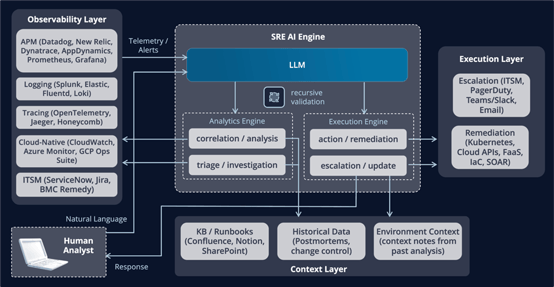
Telemetry still flows in from logs, metrics, and traces, but instead of going directly to humans, it is processed through an AI reasoning layer that incorporates context from runbooks, historical incidents, and system state. This layer performs correlation, triage, and analysis before triggering actions or recommendations through execution systems like Kubernetes, cloud APIs, or incident management tools.
This is the shift from observability to agency. Instead of asking humans to interpret signals, we are building systems that can interpret, decide, and increasingly act on their own.
A Market Converging on the Same Idea
What makes this moment particularly interesting is that the shift is not coming from a single direction. It is happening simultaneously across multiple parts of the ecosystem.
Observability platforms are pushing upward, adding intelligence to the data they already collect. Incident management tools are pushing downward, embedding automation and AI into the workflows where humans coordinate responses. At the same time, a new generation of startups is emerging with a clean-slate approach, building AI agents as the core interface for site resiliency management. Each group starts from a different place, but they all converge on the same end state: systems that can move from detection to resolution with minimal human intervention. That convergence is a strong signal this is not a feature evolution. It is a category shift.
The Subtle but Critical Shift to Action
One of the easiest ways to misunderstand this space is to assume it is just about better insights. It is not. The real differentiation is happening around execution. Many platforms can now correlate signals or suggest likely root causes. Far fewer can confidently take the next step. The question is no longer “What is happening?” but “What should we do about it, and can the system do it safely?”
This is where approaches diverge. Some systems remain advisory, surfacing recommendations for humans to execute. Others guide engineers through structured workflows. And some systems are even beginning to take action directly, with guardrails in place. That spectrum, from insight to autonomy, is where the category is being defined.
Context Is Becoming the New Data
Another important shift is the growing importance of context. Raw telemetry, even at massive scale, is not enough to drive intelligent decisions. What matters is how that data is interpreted in light of what has happened before, how the system is structured, and what changes have recently occurred. The previously provided architecture shows this with a dedicated context layer, pulling in runbooks, postmortems, and environment-specific knowledge. This allows systems to move beyond pattern matching into something closer to reasoning. In practice, this means the best platforms are not just ingesting more data. They are building an understanding and memory of the system and using it to inform decisions.
Trust Becomes the Hardest Problem
As soon as systems begin to act, a new challenge emerges: trust. Autonomous or semi-autonomous remediation introduces real risk. A misstep can amplify an incident instead of resolving it. That is why the most thoughtful approaches in this space are heavily focused on guardrails. These are not optional features. They are essential for adoption. Equally important is the role of the human. Despite the momentum toward automation, the near-term model is not one of full autonomy. It is one of collaboration. AI handles the heavy lifting of triage and analysis, while humans remain in the loop for oversight and decision-making, at least until trust is established. Over time, that balance may shift. But it will shift gradually.
For teams evaluating this space, the first question is not which vendor to choose. It is how much of your reliability workflow you are willing to delegate. Some organizations will start with augmentation, using AI to reduce toil and accelerate investigation. Others will push toward automation, aiming to reduce MTTR and scale reliability without adding headcount. The second question is integration. Systems that fit naturally into existing workflows tend to see faster adoption, while those that require entirely new interfaces often face resistance, regardless of their technical capabilities. Finally, there is the question of control. Deployment models, data ownership, and security constraints will play a major role in determining which solutions are viable, especially in enterprise environments.
Where is This Headed
The early results from this shift are already notable. Organizations are reporting meaningful reductions in incident resolution time, less operational toil, and fewer escalations. In some cases, engineers are reclaiming significant portions of their week that were previously spent on reactive work. But the deeper impact is structural. For the first time, it becomes possible to scale system reliability without scaling the size of the team responsible for it. AI acts as a force multiplier, absorbing the growing complexity that would otherwise overwhelm human operators.
This category is still early. Most solutions are in what could be considered a validating stage of maturity, where capabilities are proven in pockets but not yet fully generalized. Even so, the trajectory is clear. We are moving from systems that inform decisions to systems that participate in them. Eventually, we will arrive at systems that can operate with a high degree of independence, learning continuously from the environments they manage.
Final Thoughts
Observability gave us visibility into our systems. AIOps helped us make sense of that visibility. What comes next is different. Agentic SRE is about closing the loop. Not just understanding what is happening, but deciding what to do and taking action in real time.

Justin “Hutch” Hutchens is an Innovation Principal at Trace3 and a leading voice in cybersecurity, risk management, and artificial intelligence. He is the author of “The Language of Deception: Weaponizing Next Generation AI,” a book focused on the adversarial risks of emerging AI technology. He is also a co-host of The Cyber Cognition Podcast, a show that explores the frontier of technological advancement and seeks to understand how cutting-edge technologies will transform our world. Hutch is a veteran of the United States Air Force, holds a Master’s degree in information systems, and routinely speaks at seminars, universities, and major global technology conferences.